1 · Find your spark
Story starter generator
Pick a genre, then explore an idea. The grade changes the writing guidance; an adult can read the story ingredients aloud.
Who?
A careful mapmaker
Where?
an island missing from every map
What gets in the way?
They need to return a lost key before sunset
An unexpected turn
A tiny door appears in a place that was empty before
Write what happens next and show how the character tries to solve the problem.
Your story text stays in this page and is not saved when you leave. Copy or print it to keep your work.
Want just the tool? Story Starter Generator has its own page — easier to bookmark and to pass on.
A blank page can make even an eager young writer forget every idea they have ever had. A story starter removes one decision: where to begin. It should open a door without deciding what waits on the other side.
The generator above combines four curated ingredients—a character, setting, problem, and surprise—with a writing direction for the selected grade. It does not write the story, score the response, or send a child’s choices to a server. The writer remains in charge of every important decision.
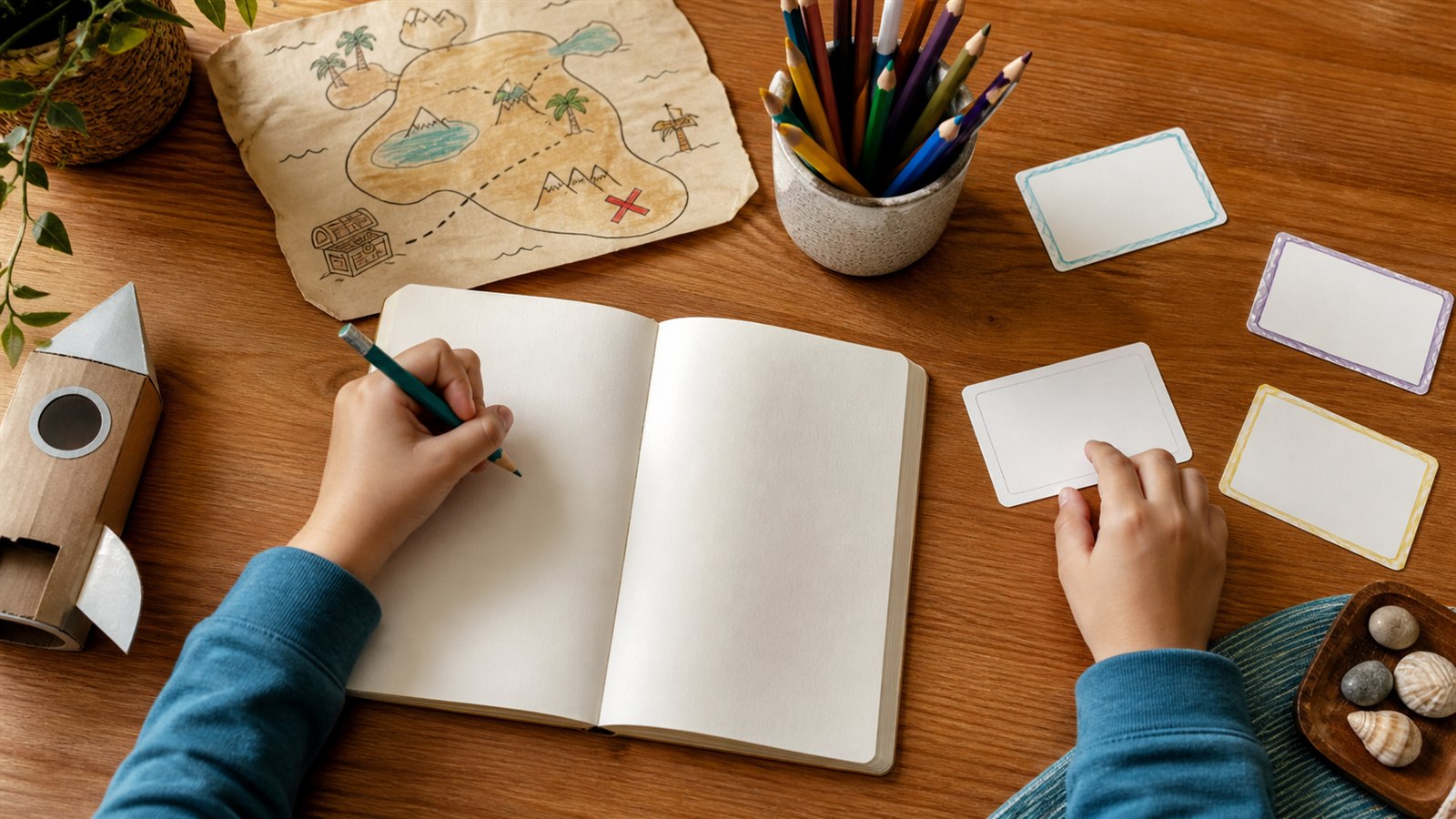
Choose Plan this story to open a three-page notebook for beginning, middle and ending ideas. You can browse another starter without changing the idea attached to your writing. If you choose Use this idea in my plan, the new idea replaces the starting prompt and your writing stays in place. Copy or print the completed plan before leaving: it is not saved after the page closes.
How to use the story starter generator
- Choose a grade. The grade changes the suggested writing challenge, not the imagination required. Move up or down whenever another level fits the writer better.
- Choose a genre. Adventure, mystery, fantasy, animals, everyday life, and science fiction each use their own set of story ingredients.
- Generate more than one idea. Read two or three starters before choosing. Comparing possibilities helps a child notice what they actually want to write.
- Change anything. Swap the character, move the setting, remove the surprise, or combine parts from different starters. The generated words are an invitation, not a rule.
- Talk or sketch before drafting. A quick drawing, list, story map, or oral rehearsal can turn a promising idea into a sequence of events.
The tool works well for a short quick-write, a longer narrative, a comic, a dictated story, collaborative storytelling, or a family writing game. For a larger collection of narrative, opinion, descriptive, and reflective ideas, browse our 300 writing prompts for grades K–5.
What can writers do at each grade?
Grade labels are useful guides, but they are not limits. Children in the same classroom can differ greatly in language, handwriting, spelling, experience, confidence, and stamina. Choose a response form that lets the child work on the intended skill.
Kindergarten
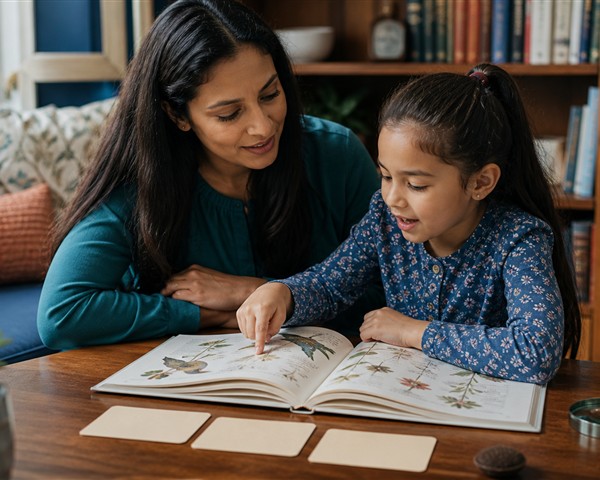
A response might be a drawing, labels, invented spelling, a dictated sentence, or a story told aloud. Ask the child to point to the character and describe what is happening. An adult can write down the child’s exact words when transcription would otherwise hide the idea.
First grade
Invite the writer to show what happens first and next. One or two connected sentences can be a complete response. Read the draft aloud together and ask whether it says what the writer meant.
Second grade
Focus on a character trying to solve the generated problem. Encourage a few ordered events and details that help the reader picture the action. A simple beginning-middle-ending plan can be enough.
Third grade
Develop the sequence and connect events with time, cause, or consequence. The generated surprise can become the turning point between the middle and ending rather than an unrelated event added at the end.
Fourth grade
Ask how the surprise changes the character’s first plan. Writers can add dialogue, description, and internal thinking selectively, choosing details that move the story rather than trying to decorate every sentence.
Fifth grade
Experiment with point of view, pacing, tension, and an ending that grows from earlier choices. Revision might mean moving a clue, cutting an unnecessary event, strengthening a character’s motivation, or clarifying why the outcome matters.
Turn a starter into a simple story plan
Children do not need a complicated worksheet before every story. Four questions can provide enough structure:
- Who wants something? Give the main character a specific goal.
- What gets in the way? Decide why the generated problem is difficult.
- What do they try? Let the first attempt reveal something or create a consequence.
- What changes? Use the surprise to alter the plan, the character, or the reader’s understanding.
For younger writers, ask the questions aloud and capture answers with pictures or keywords. Older writers can turn each answer into a scene. If the plan starts feeling more interesting than the original prompt, follow the plan—the purpose of a starter is to make itself unnecessary.
Help without taking over the story
Adults can support idea development while protecting the child’s ownership. Try prompts such as:
- “Tell me more about that part.”
- “What does your character want the reader to understand?”
- “Which moment can you picture most clearly?”
- “What might the character try before the final solution?”
- “Do you want a suggestion, a question, or quiet writing time?”
Respond to meaning before correcting conventions when idea generation is the goal. Name one specific strength: an effective detail, a clear sequence, a surprising choice, or a line that sounds like the writer. Save spelling, punctuation, and sentence work for a separate pass with a clear focus.
The Institute of Education Sciences recommends regular time for writing, explicit teaching of the writing process, foundational skill development, and an engaged community of writers. A generator can help with the first spark, but it cannot replace instruction, useful feedback, revision, or authentic choice.
When a child says “I still don’t know what to write”
Generating more prompts is not always the answer. Too many options can become another obstacle. Instead, change the way into the task:
- Let the child choose just one ingredient and invent the rest.
- Act out the opening scene with toys or simple props.
- Take turns telling one sentence at a time before writing anything down.
- Draw three boxes for the beginning, middle, and ending.
- Start with dialogue, a sound, or an action instead of background information.
- Write together, with the adult holding the pencil but the child choosing the words.
- Offer permission to pass and return later.
Some children need a smaller task; others need greater freedom. A child who resists the generated idea may already be telling you what kind of story they would rather create. You can also use questions, observation, and playful constraints to spark curiosity in young readers and writers.
Classroom and home ideas
A three-minute oral warm-up
Generate one starter for the group. Ask children to tell a partner one possible next event. Hearing different answers demonstrates that the same beginning can lead to many valid stories.
Mix-and-match planning
Generate three starters and keep one ingredient from each: perhaps the character from the first, setting from the second, and surprise from the third. This makes selection and revision part of idea generation.
Pass-the-story collaboration
One writer creates the opening, another adds a complication, and a third works toward an ending. Agree in advance that collaborators may build on an idea without erasing what came before.
A real audience
When the writer is comfortable, share the finished work with a classmate, relative, reading buddy, or classroom collection. Writing becomes more purposeful when it communicates with someone beyond the person assigning it.
Keep prompts safe and inclusive
No child should have to disclose trauma, health information, family finances, immigration status, religion, or another private experience to complete a writing activity. Fiction, alternative prompts, and the option to pass should always remain available.
Avoid treating one family structure, dialect, culture, ability, or way of communicating as the default. Drawing, speech-to-text, typing, dictation, and handwriting can all be appropriate tools; the best choice depends on whether the current goal is idea development, composition, transcription, or conventions.
Sources and further reading
- Teaching Elementary School Students to Be Effective Writers, Institute of Education Sciences and What Works Clearinghouse, revised 2018.
- Toolkit to Support Evidence-Based Writing Instruction in Grades 2 Through 4, Institute of Education Sciences.
- The Students’ Right to Write, National Council of Teachers of English, 2026.
- Professional Knowledge for the Teaching of Writing, National Council of Teachers of English.