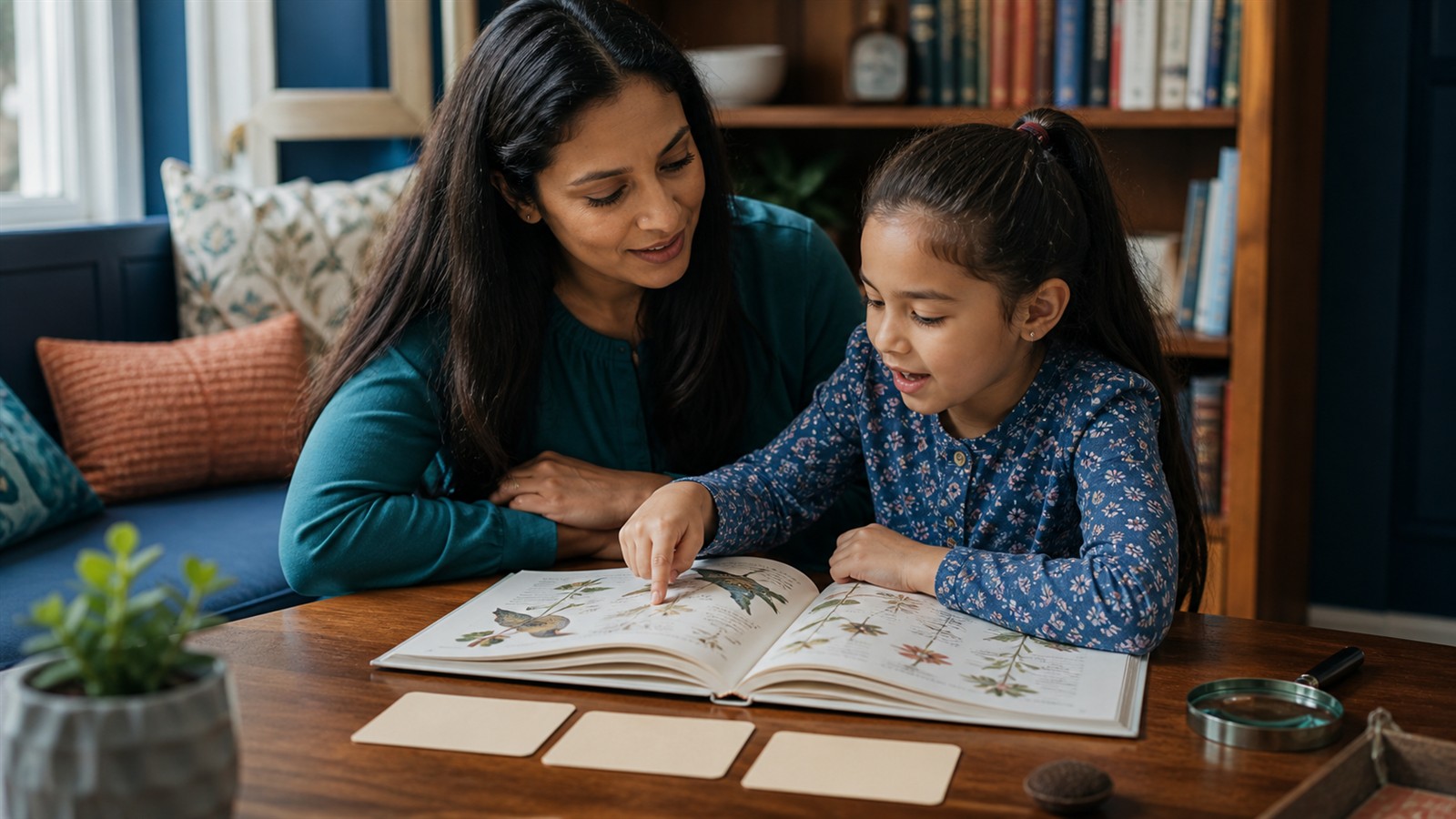
Free, private conversation tool
Build reading discussion cards
Choose a grade band, text type, and reading stage. Use one question when it helps; skip any card that interrupts the reading.
Conversation set
6 questions to choose from
- Before reading
Does this book remind you of another story or experience?
Ask: “What makes you think that?” when a follow-up would help. - Before reading
What clues do the title, cover, and summary give about the story?
Ask: “What makes you think that?” when a follow-up would help. - During reading
What is the character learning or beginning to understand?
Ask: “What makes you think that?” when a follow-up would help. - During reading
What does the main character want, and what is getting in the way?
Ask: “What makes you think that?” when a follow-up would help. - After reading
What would change if another character told the story?
Ask: “What makes you think that?” when a follow-up would help. - After reading
Summarize the story using the most important events only.
Ask: “What makes you think that?” when a follow-up would help.
Nothing you select is saved or sent. Good reading talk follows the child’s thinking rather than testing every page.
Six original passages · free to print
Practise on a passage together
Four short stories and two informational texts, written for this site. Each one has three questions: one the passage answers outright, one the reader has to work out, and one worth talking about. Nothing here is scored, and no answer is recorded.
Story · Grades 1–2 · about 98 words
The Sock with the Blue Stripe
Who it fits Reads short sentences on their own and can retell what happened in order.
Help to expect Most readers manage this alone. Read the last paragraph together if the joke in it goes past them.
Milo had one sock with a blue stripe. He could not find the other one.
He looked under his bed. He found a book and one broken crayon.
He looked in the laundry basket. He found his rain boots.
Then he heard a small sound from the closet. Thump. Thump.
Milo opened the door. His puppy, Bean, was asleep on a pile of towels. The sock with the blue stripe was under her chin.
Milo did not wake her up. He wore one blue sock and one red sock to school. All day, he smiled at his feet.
Find it The answer is stated in the passage.
Where was the missing sock?
Work it out The passage does not say it outright. Clues add up to it.
Why did Milo go to school wearing two socks that did not match?
Talk it over No single right answer. Listen for reasons, not for the answer you expected.
Milo smiled at his feet all day. What do you think he was remembering?
Take it off the screen
Printing gives a reader’s page with the passage, its questions and room to write, then a separate page of answers and evidence for the grown-up.
Questions of your own to ask? Build a set with the discussion cards above, or find another way to read together in our reading games for kids.
GrowMindGrow · Read, think, talk
The Sock with the Blue Stripe
Story · Grades 1–2 · about 98 words
Milo had one sock with a blue stripe. He could not find the other one.
He looked under his bed. He found a book and one broken crayon.
He looked in the laundry basket. He found his rain boots.
Then he heard a small sound from the closet. Thump. Thump.
Milo opened the door. His puppy, Bean, was asleep on a pile of towels. The sock with the blue stripe was under her chin.
Milo did not wake her up. He wore one blue sock and one red sock to school. All day, he smiled at his feet.
Find it
Where was the missing sock?
Work it out
Why did Milo go to school wearing two socks that did not match?
Talk it over
Milo smiled at his feet all day. What do you think he was remembering?
GrowMindGrow · Grown-up copy
Answers and evidence
The Sock with the Blue Stripe · matches the reader’s page
Find it · The answer is stated in the passage.
Where was the missing sock?
In the closet, under the puppy’s chin, on a pile of towels.
In the passage: “His puppy, Bean, was asleep on a pile of towels. The sock with the blue stripe was under her chin.”
Work it out · The passage does not say it outright. Clues add up to it.
Why did Milo go to school wearing two socks that did not match?
He decided not to take the sock, because taking it would have woken Bean. The story never says he chose the red sock instead; the reader has to put those two facts together.
In the passage: “Milo did not wake her up.”
Talk it over · No single right answer. Listen for reasons, not for the answer you expected.
Milo smiled at his feet all day. What do you think he was remembering?
Listen for an answer that reaches back to the closet — the puppy asleep, the sock he left behind, a secret only he knows. A reader who says “because his socks looked funny” has understood the picture but not the reason; ask what made them funny.
Want just the tool? Reading Discussion Cards has its own page — easier to bookmark and to pass on.
The best reading question is not necessarily the hardest one. It is the one that helps a child notice, connect, explain, wonder, or revise an idea without breaking the experience of reading.
Use the discussion-card builder above to create a short set for a grade band, fiction or informational text, and a point in the reading. You do not need to ask every question. Choose one when conversation would add meaning, listen to the answer, and follow the child’s thinking.
If you do not have a book to hand, the passage practice below the builder has six short texts written for this site — four stories and two informational pieces — each with three questions and the evidence behind the answers. Nothing there is scored.
Why ask questions before, during, and after reading?
Each stage can support a different part of comprehension:
- Before reading, a child previews the text, activates useful background knowledge, notices text features, sets a purpose, and makes an initial prediction or question.
- During reading, a child monitors understanding, connects events or ideas, interprets words and visuals, makes inferences, and adjusts earlier thinking.
- After reading, a child identifies what mattered, supports an interpretation, summarizes, evaluates the text, and connects the learning with another context.
The Institute of Education Sciences’ K–3 reading comprehension toolkit recommends teaching comprehension strategies, helping students use narrative and informational text structures, and guiding focused, high-quality discussion about meaning. Its guidance emphasizes questions that require deeper thinking and follow-up questions that help a discussion develop.
That does not mean stopping after every page. A conversation should complement the text, purpose, and reader—not compete with them.
Questions to ask before reading
Before-reading talk works best when it opens a genuine reason to read. Look at the title, cover, headings, pictures, captions, diagrams, or table of contents. Ask one question that helps the child enter the text.
For fiction, try:
- What clues suggest where or when this story happens?
- What problem, character, or feeling do you expect to meet?
- What does the cover make you wonder?
- What do you know about stories in this genre?
For informational text, try:
- What do you already know about this topic, and where did you learn it?
- What question do you want the text to answer?
- How do the headings and graphics suggest the information will be organized?
- What vocabulary may be important?
Background knowledge should support curiosity, not become a gatekeeping quiz. If a topic is unfamiliar, briefly supply essential context. A child does not have to prove what they already know before being allowed to learn something new.
Questions to ask during reading
During-reading questions help a reader notice whether the text makes sense. Pause at a natural point: a scene change, important decision, surprising fact, new section, confusing sentence, or moment when the child reacts.
Useful prompts include:
- What changed here?
- What does the character want, and what is in the way?
- Which detail makes you think that?
- Does this new information change your prediction?
- What is the main point of this section?
- How does the picture, chart, example, or diagram help?
- Is there a word or part we should reread?
“What makes you think that?” is often more productive than immediately judging an answer. It invites the child to return to the words, illustrations, structure, or prior events and make their reasoning visible.
If the child says, “I don’t know,” reduce the demand. Offer two parts to compare, reread a short section aloud, point to a visual, think aloud about your own uncertainty, or simply continue reading. Not every gap must be solved on the spot.
Questions to ask after reading
After-reading questions should help a child build a coherent understanding rather than recall isolated trivia. Begin with a broad invitation:
- What will you remember about this text?
- What changed in your thinking?
- What would you tell someone who has not read it?
Then deepen the conversation if the child is engaged.
For fiction, ask about the character’s goals and choices, how events connect, the effect of point of view, possible themes, or a moment that can be interpreted in more than one way. For informational text, ask for the main idea or claim, important evidence, the author’s organization and purpose, an application, or a question that requires another reliable source.
A summary is more than a list of details. Help the child decide what must stay and what can be left out. Younger children can retell with pictures, objects, gestures, or “first, next, last.” Older children can explain how selected evidence supports a central idea.
Match the question to the reader, not only the grade
The grade bands in the tool are starting points. Select a different band when the language or thinking demand fits the child better. A strong conversation can happen through speech, drawing, pointing, acting, home language, augmentative communication, or writing.
For kindergarten and first grade, pictures are part of the text, not decorations. Ask children what an illustration reveals that the words do not. Accept oral retelling and invented language. Read the words aloud when decoding would otherwise consume all the child’s attention.
For grades 2–3, help readers connect events and ideas, notice text structure, explain new vocabulary in context, summarize, and point to evidence.
For grades 4–5, invite multiple interpretations, analysis of point of view and author craft, evaluation of evidence, and comparison across texts or sources. Complexity should come from thinking, not from making the wording of the question unnecessarily difficult.
Keep reading talk from becoming a quiz
Children quickly notice when every pause is a test with one answer already in the adult’s head. Protect the relationship and the reading experience:
- Share your own noticing and wondering sometimes.
- Ask fewer questions and allow longer answers.
- Respond to the idea before correcting grammar or pronunciation.
- Let the child ask the questions.
- Accept an interpretation that differs from yours when the text can support it.
- Admit when you need to reread or learn more.
- Stop asking when the conversation interrupts momentum.
Try “Tell me more,” “Show me the part,” or “I had not thought about it that way.” Those responses communicate that reading is meaning-making, not answer delivery.
Our guide to sparking curiosity in young readers and writers offers more ways to make questions feel like invitations rather than evaluations.
Support comprehension when decoding is difficult
Word reading and language comprehension both matter. A child may have rich ideas about a story they hear while still working hard to decode the printed words. Reading aloud, audiobooks, paired reading, and accessible text-to-speech can provide access to age-interesting ideas while explicit instruction develops foundational reading skills.
Do not use good oral comprehension to dismiss a decoding difficulty, and do not use difficult decoding to assume the child cannot think deeply. Share persistent concerns with the teacher and ask what instruction and evidence the school is using.
The IES practice guide for reading interventions in grades 4–9 similarly includes building world and word knowledge and providing opportunities for students to understand and discuss text, alongside work on decoding and fluency for students who need it.
Use fiction and informational texts differently
Stories and informational texts overlap, but their structures invite different questions.
In fiction, readers often track characters, setting, goals, conflict, events, point of view, and theme. Ask how one choice causes another event or how the narrator shapes what the reader knows.
In informational text, readers may follow description, sequence, comparison, cause and effect, or problem and solution. Ask how headings and visuals organize meaning, how evidence supports a claim, and what needs verification elsewhere.
Some texts blend forms: narrative nonfiction, biography, documentary comics, essays, or historical fiction. Choose the questions that fit what the text is doing rather than forcing it into a label.
Turn reading talk into writing
A strong discussion can become a low-friction writing invitation:
- Write a missing scene from another character’s point of view.
- Explain the most important fact to a younger reader.
- Compare two characters, explanations, or sources.
- Record a claim and the detail that best supports it.
- Write the next question you would investigate.
The child can use our story starter generator for imaginative extensions or browse writing prompts for grades K–5 for other forms. Discussion first can give a writer language and ideas without dictating the response.
A simple five-minute routine
When time is short:
- Before reading, ask one noticing or wondering question.
- Read without interruption until a natural pause.
- During reading, ask one question about meaning or confusion.
- After reading, ask what mattered most and why.
- End with the child’s question, not the adult’s final test.
That is enough. Consistent, interested conversation matters more than completing a worksheet or displaying every strategy in one sitting.
Sources and further reading
- Toolkit for Teaching K–3 Reading Comprehension, Institute of Education Sciences and Regional Educational Laboratory West.
- Improving Reading Comprehension in Kindergarten Through 3rd Grade, What Works Clearinghouse practice guide.
- Providing Reading Interventions for Students in Grades 4–9, What Works Clearinghouse practice guide, 2022.
- Reading for Meaning with Your Child, Reading Rockets.