Free fiction and nonfiction organizer
Build a book report template
Choose a grade band and text type. Fiction gets a story map; nonfiction gets a main-idea organizer. Fill it in here, or print it blank with room to draw and write.
Report heading
Your book report
Add the author above.
6 grade-aware sections are ready to complete.
Nothing typed here is saved or sent. Copy or print before leaving if you want to keep the work.
GrowMindGrow · Book report · Fiction
Title
Story map
Who are the important characters?
How does the setting matter?
What problem does the character face?
What are the most important events?
How is the problem solved?
Thinking about the book
What is your response to the book?
Want just the tool? Book Report Template has its own page — easier to bookmark and to pass on.
A useful book report helps a child select, organize, and communicate their understanding. It should not turn reading into a hunt for isolated facts or require a first grader and fifth grader to complete the same form.
The template builder above changes its prompts by grade band and by text type. Fiction prompts focus on character, setting, conflict, events, theme, craft, and response. Informational prompts focus on topic, central ideas, supporting details, structure, vocabulary, evidence, purpose, and questions for further research.
How to use the book report template
- Choose the grade band that fits the learner’s current task.
- Choose fiction or informational and nonfiction text.
- Enter the book title and author.
- Read all prompts before writing.
- Talk, draw, mark pages, or use notes to plan answers.
- Respond in the child’s own words.
- Copy or print before leaving the page because entries are not stored.
The form is an organizer, not an assignment requirement. Follow the teacher’s directions when they differ, and delete or skip prompts that do not fit the particular book.
Book report, summary, and review are different
A summary condenses the most important ideas or events in the reader’s own words. A book report may include a summary plus information about characters, setting, structure, theme, evidence, or learning. A book review makes and supports an evaluation for a potential reader.
Many school assignments combine the three. Before drafting, ask what the final piece is meant to accomplish. Is the child showing comprehension, analyzing how the book works, teaching others about a topic, or recommending the book?
Reading Rockets describes summarizing as identifying essential ideas, leaving out less important information, and integrating the central points in a shorter form. That is a demanding comprehension skill, not copying sentences from the book.
Kindergarten and grade 1: begin with oral retelling
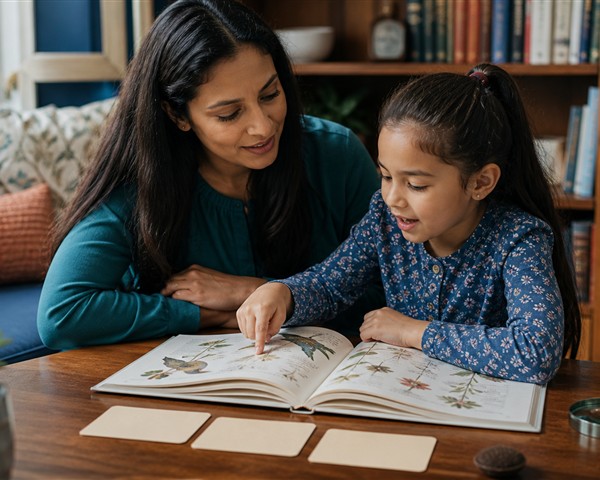
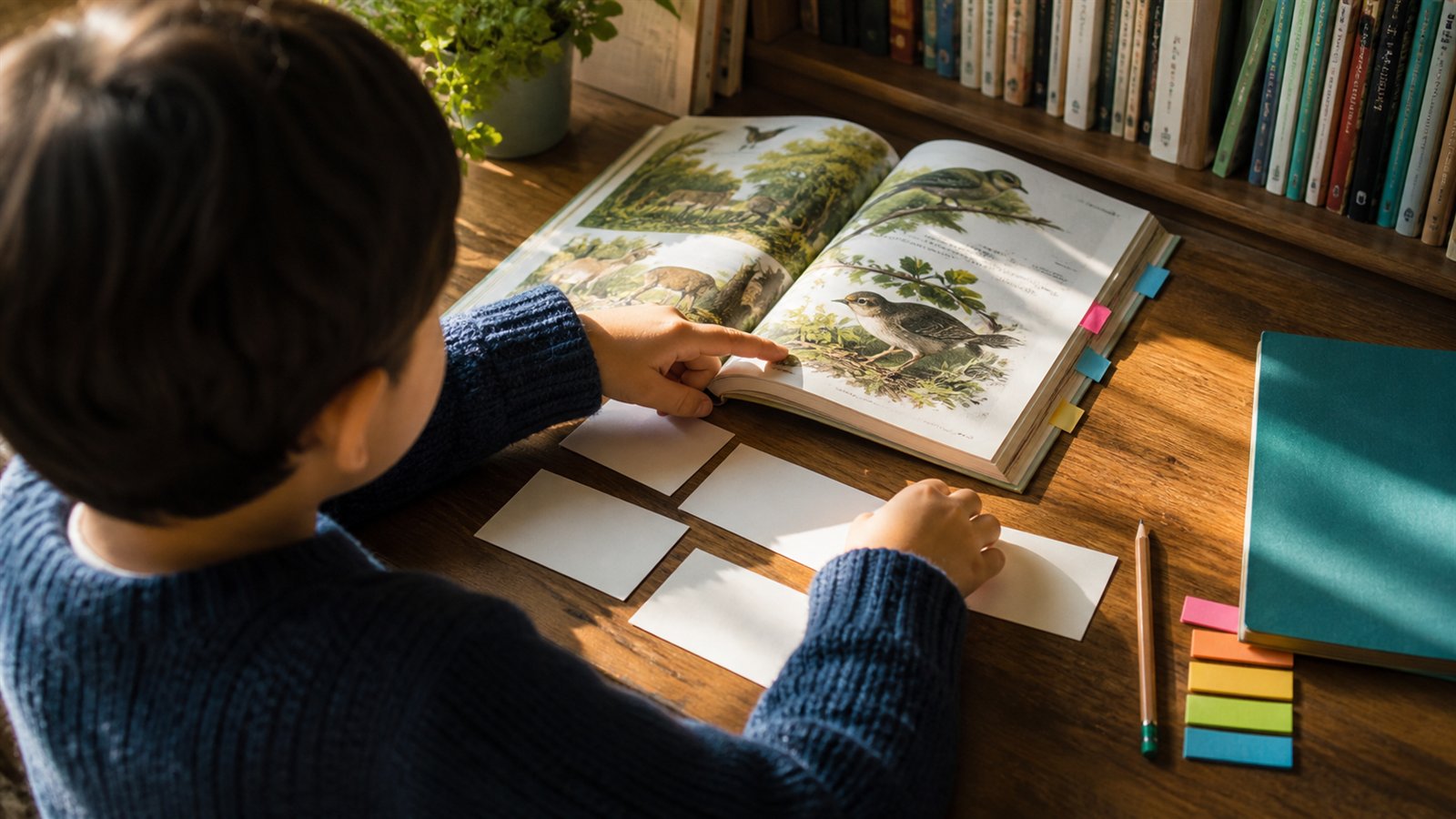
Young children do not need to write paragraphs to demonstrate thoughtful reading. Let the child speak, draw, point, act, sequence picture cards, or dictate to an adult.
For fiction, ask who the story is about, where it happens, and what happens first, next, and last. For informational text, ask what the book is mostly about, what the child learned, and how a picture or heading helped.
Write down the child’s exact language when acting as a scribe. Avoid quietly replacing it with an adult summary. The purpose is to preserve the child’s thinking while reducing the transcription demand.
Grades 2–3: connect important parts
Readers in this band can begin moving from a full retelling toward a selective summary. In fiction, connect what a character wants, the problem, important responses, and the outcome. In informational text, connect a main idea with the details that support it.
A strong response does not need to be long. Ask the child to explain why a chosen detail belongs. If every event or fact appears equally important, compare two items and decide which one the reader most needs to understand the book.
The Institute of Education Sciences K–3 comprehension toolkit recommends explicit work with strategies such as summarizing and retelling, asking and answering questions, monitoring comprehension, and using narrative and informational text structures.
Our reading comprehension question cards can support discussion before a child begins writing.
Grades 4–5: move from recall to analysis
Older elementary reports can ask how and why, not only who and what.
For fiction, a child might explain how a character changes, how events develop a theme, or how point of view affects what the reader knows. For nonfiction, a child might connect central ideas, evaluate selected evidence, explain the structure, or identify a claim that needs another reliable source.
Evidence should serve the explanation. One carefully chosen event, fact, example, or short quotation is usually more useful than several unconnected details. Ask the child to state the idea first, then choose the evidence that best helps a reader understand it.
How to write a concise fiction summary
Try this sequence:
- Name the central character and situation.
- State the character’s important goal or conflict.
- Select the events needed to understand how that conflict develops.
- Explain the resolution without recounting every scene.
- Remove opinions that belong in the response or review section.
For a first draft, a structured prompt such as somebody, wanted, but, so, then can help a child locate the story’s spine. Treat it as temporary support, not a required formula for every text.
How to summarize informational text
Begin with the topic, then identify what the author most wants the reader to understand about that topic. Group details under central ideas rather than following the book page by page.
Notice the structure. A text may describe a subject, explain a sequence, compare examples, trace causes and effects, or present a problem and possible solutions. Headings, captions, diagrams, timelines, and tables can reveal how the ideas connect.
Ask which details are essential, which are examples, and which are interesting but unnecessary for a concise summary.
Help without writing the report for the child
Adults can reduce friction while leaving the intellectual work with the learner:
- Clarify the assignment and audience.
- Help locate marked pages or notes.
- Read a prompt aloud.
- Ask the child to explain an idea orally before writing.
- Record dictated language when transcription is not the learning goal.
- Help separate a long answer into sentences or sections.
- Ask which evidence best supports the child’s own claim.
- Proofread after the ideas are established.
Do not supply a theme, evaluation, or interpretation and ask the child to copy it. A simpler authentic response is more useful than polished adult prose.
For additional writing choices, browse the K–5 writing prompt collection or use the story starter generator to imagine an extension from a book.
Adapt the format for accessibility
A report can be spoken, recorded, drawn, typed, signed, assembled with picture supports, or created with assistive technology when that matches the learning goal and the teacher’s expectations.
Separate comprehension from handwriting, spelling, decoding, and typing when possible. Difficulty with one mode does not reveal the full depth of a child’s understanding.
For multilingual learners, discussing the book in a home language can support idea development before producing the required final language. Preserve accurate names and topic vocabulary while allowing the child to build meaning with all available language resources.
A final self-check
Before submitting, ask:
- Did I answer the actual assignment?
- Is the summary in my own words?
- Did I select important details instead of listing everything?
- Does my evidence support the idea beside it?
- Did I separate summary from opinion?
- Are the title and author accurate?
- Is there a sentence or section that needs clarification?
The finished report should make the child’s thinking visible. It does not need to make every child sound like the same writer.
Sources and further reading
- Summarizing, Reading Rockets.
- Toolkit for Teaching K–3 Reading Comprehension, Institute of Education Sciences and Regional Educational Laboratory West.
- Improving Reading Comprehension in Kindergarten Through 3rd Grade, What Works Clearinghouse.