Good multiplication games give a child a reason to work out a fact and a way to check it. Dice and cards can supply the numbers. Arrays, explanations, and related facts supply the mathematics. Begin with a game the child can understand, then change the facts as their strategies grow.
Download the free multiplication games pack (PDF, 6 pages) — all seven game instructions, a product-cover board, an array mat, a strategy mat, number cards, a multiplication table, and missing-factor cards with hidden answers. No signup is required.
Most games take five to ten minutes and work with a partner or an adult. Each also has a solo or cooperative version. Set the materials out before starting so your practice time goes into playing rather than finding counters.
What should third-grade multiplication practice include?
Children need to connect multiplication to equal groups and arrays, use relationships between facts, and eventually recall products efficiently. The grade-three operations standards connect multiplication and division with those ideas. They include fluent calculation within 100 and recall of products of two one-digit numbers by the end of the grade.
That is an end-of-grade direction, not a demand that every child know every fact in September. Follow the school’s sequence and start where the child can explain what the numbers mean.
If 3 × 4 is still only a string of symbols, begin by building three equal groups of four. If the groups make sense but 6 × 4 is uncertain, use a known fact such as 5 × 4 and add one more group. If the child can derive the facts reliably, short mixed practice can help recall become more efficient.
Choose the game that fits the next step
| Game | Best starting purpose | Materials |
|---|---|---|
| Roll, build, and turn | Connect rows, groups, and factors | Two dice, counters, array mat |
| Cover a product | Revisit facts with factors 1–6 | Two dice, board, counters |
| Double the known fact | Derive 4s and 8s from 2s | Number cards, strategy mat |
| Five and a bit | Derive 6s, 7s, 8s, and 9s | Number cards, counters |
| Missing factor detective | Connect multiplication and division | Foldable fact cards |
| Same product hunt | Find different factor pairs | Number cards, paper |
| Make a multiplication story | Apply a fact to an equal-groups situation | Number cards, drawing paper |
Two ordinary dice produce factors 1–6 only. Use the printable 0–9 cards when you want to include 7, 8, and 9. With ordinary playing cards, remove 10s and face cards, use ace as 1, and agree the values before playing. Keep small counters away from younger siblings who might put them in their mouths.
1. Roll, build, and turn
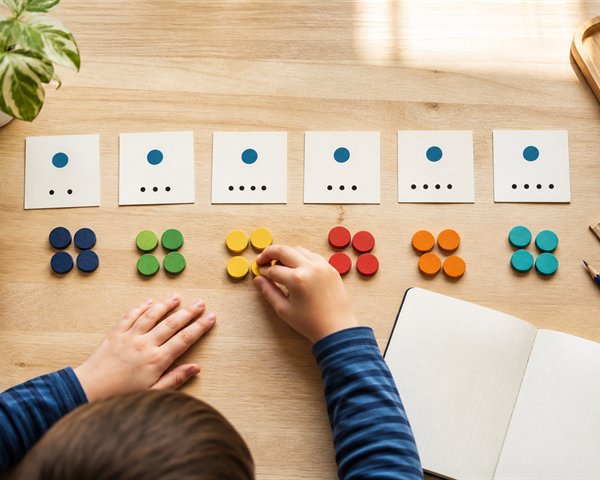
Roll two dice. The first number gives the number of rows; the second gives the counters in each row. Build the array on the printable mat and write its equation.
For a roll of 3 and 4, build three rows of four. Ask how the child can find the total without counting every counter individually. They might count 4, 8, 12 or combine two rows of four and another four.
Turn the mat a quarter turn. The same counters now make four rows of three: 3 × 4 = 12 and 4 × 3 = 12. The total stays the same even though the rows change.
Partners alternate building and checking for five rounds. A solo player builds, records, turns, and checks. If dice introduce too much uncertainty, choose the two factors yourself.
2. Cover a product
Use two dice and the six-by-six product board. Roll, multiply, explain the answer, then cover one matching free square. If every square showing that product is already covered, take no square this turn.
Two players use different counters and alternate turns. The first to cover four squares in a line—horizontal, vertical, or diagonal—wins. A full board with no line is a draw. Solo players can try to make a line within 12 rolls, then start fresh.
For 4 × 6, an explanation might be “Two sixes are 12, so four sixes are 24.” Check after the explanation using counters or the pack’s table. Keep errors out of the scoring: help the child repair the calculation and continue.
The board contains every possible product from two six-sided dice. Some numbers repeat, so players choose which matching space to cover. Dice do not generate all products equally often; the game offers repeated practice, not a balanced assessment of every fact.
3. Double the known fact
Choose a fact the child already knows, then double one factor and its product. Write the linked facts on the strategy mat:
2 × 6 = 12 → 4 × 6 = 24 → 8 × 6 = 48
Build the groups if needed. Four groups of six are twice as many groups as two groups of six. The doubling has a reason; it is not a rule about moving digits around.
Take turns choosing a starting fact, or work through three fact chains alone and check with the table. Keep factors within 1–9 for this version. To make it easier, stop after one double. To make it harder, ask which smaller fact could help find a given larger one.
4. Five and a bit
Draw a first factor from 6, 7, 8, or 9 and a second from 1–9. Split the first into five and the remainder. Use counters or draw an array with a line separating the two parts.
For 7 × 4, split seven groups into five groups and two groups:
7 × 4 = (5 × 4) + (2 × 4) = 20 + 8 = 28
Ask the child to point to where both products appear in the drawing. If they write 20 + 2, the picture shows why the second part must include two groups of four rather than two extra counters.
Complete four different facts together or independently. The child chooses whether to draw, build, or explain mentally. Later, compare with another valid strategy, such as finding eight groups and subtracting one.
5. Missing factor detective
Cut out the printable fact cards and fold each answer column behind its card. Read 6 × ? = 42 without exposing the missing factor. Work it out, explain the method, then unfold to check.
The child might know 6 × 7 = 42, count in sixes, or use 6 × 5 = 30 and two more groups of six. Connect the result to division: 42 ÷ 6 = 7.
Partners alternate being the detective and checker. A solo player keeps uncertain cards in a small revisit pile. There is no penalty for choosing a strategy instead of recalling immediately.
For homemade cards, use two nonzero factors for a missing-factor problem. An equation such as 0 × ? = 0 does not have a unique missing number, so it cannot be graded like the cards in this pack.
6. Same product hunt
Choose a target from 12, 18, 24, or 36. Using factors from 1–9, find every pair that makes the target. Record turn-around facts, but count each unordered pair once.
For 12, the pairs are 2 × 6 and 3 × 4. Writing 6 × 2 is useful, but it describes the same pair as 2 × 6. The pair 1 × 12 does not qualify because 12 is outside this game’s card range.
Work cooperatively or alone. Use the multiplication table to check that no pair is missing. The pack includes the complete key for all four targets.
For an extension, choose a target with a different number of pairs and explain why. For example, 16 has 2 × 8 and 4 × 4, while 17 has none within the game’s 1–9 range. “No matching pair” can be a correct result.
7. Make a multiplication story
Draw two cards from 1–9 and put them back after the turn. Make a short equal-groups story using the factors. For 4 and 6:
“Four bags hold six apples each. How many apples are there altogether?”
The listener draws four groups, labels six in each, and solves 4 × 6 = 24. Then change the question: “If 24 apples are shared equally into four bags, how many go in each?” The answer is six.
Partners swap storyteller and solver roles. A solo player makes a story, draws it, and checks the equation. It is fine for an adult to write the words when handwriting would consume the session.
For fresh situations with explanations, use the free math word-problem generator. Choose a grade band and operation that match the child’s current work.
How to make practice easier or harder
If equal groups are unclear: Choose small factors and build the groups. Stay with the array game before adding a board’s winning rules.
If the idea is clear but recall is slow: Keep counters or a strategy mat available. Ask which known fact would help. A correct explanation gives you something to build on.
If the child recalls familiar facts but misses mixed ones: Combine a small number of new facts with known ones. Include turn-around facts and missing factors so the pattern is not simply the order of a memorized list.
If everything is easy: Ask for a second method, a matching division statement, or a story. Making every game faster is not the only way to add challenge.
Keep the session short enough to end with attention left. Our ten-minute home-math guide covers earlier foundations; the growth mindset activities help turn a difficult round into a specific strategy to try next.
What to notice after a week
Listen for one useful change: the child can build equal groups, chooses a known fact without prompting, explains the missing factor, or checks an answer independently. Record the fact or strategy rather than labeling the child “good” or “bad” at multiplication.
The pack is practice, not a standardized test or proof of grade-level mastery. Share persistent sticking points with the teacher so home games can support the same concepts being taught in class.