Read it · Picture it · Work it out
Generate a math word problem
Try one together, or make a five-problem practice set. Every story comes with a visual model and a worked answer.
Changing a grade, operation or theme starts new practice and clears your work. Pick by readiness; younger children may need the story read aloud.
One small story
A wildlife helper has 82 food portions and receives 82 more. How many food portions are there now?
Picture the story
Enter the number that answers the story.
Your answers and notes stay on this page and are cleared when you leave or start new practice. They are not included in usage analytics. Printing creates blank learner pages and the worked answers.
Want another way to practice? Find a hands-on math activity or try multiplication boards and equal groups.
GrowMindGrow · Read, picture, solve
Math word problems
Grades 2–3 · Addition · Animals
Practice 2-3 / add / animals / 1 · Learner page 1
1. A wildlife helper has 82 food portions and receives 82 more. How many food portions are there now?
Draw or explain your thinking.
My answer: ____________________
GrowMindGrow · Grown-up copy
Worked answers
Grades 2–3 · Addition · Animals
Practice 2-3 / add / animals / 1 · Matches the learner pages
1. A wildlife helper has 82 food portions and receives 82 more. How many food portions are there now?
82 + 82 = 164
Join the two quantities because the second amount is added to the first.
Want just the tool? Math Word Problem Generator has its own page — easier to bookmark and to pass on.
Word problems ask a learner to do more than calculate. The child must understand a situation, decide which quantities and relationships matter, represent the situation mathematically, compute, and decide whether the answer makes sense.
The generator above creates bounded practice problems with verified arithmetic. It does not send a prompt to an AI system. Each problem is assembled locally from hand-authored structures, age-aware number ranges, and a selected theme.
How to use the math word problem generator
- Choose a grade band.
- Choose an available operation.
- Pick a context that feels approachable.
- Read the problem without immediately searching for a keyword.
- Draw, act out, or model the quantities.
- Enter an answer and check it.
- Reveal the equation when the representation or operation needs discussion.
The grade bands are broad practice starting points, not a claim that every generated problem matches a particular school’s pacing or a child’s current instruction. Choose a different band when its numbers and operations fit better.
Why word problems can feel harder than equations
A learner may calculate accurately and still struggle to interpret a situation. The language may be unfamiliar. The question may describe a relationship the child has not learned to represent. A child may also choose an operation from one noticed word rather than from the complete meaning.
For example, more can appear in an addition situation, but it can also appear in a comparison question that requires subtraction. Shared can suggest division, but the question still needs to establish equal groups and identify what is unknown.
Instead of asking Which keyword tells you the operation?, ask:
- What is happening in this situation?
- What quantities do we know?
- What are we trying to find?
- Are quantities being joined, separated, compared, grouped, or measured?
- What drawing, objects, table, or equation could represent that relationship?
The Institute of Education Sciences practice guide for students struggling with elementary mathematics recommends systematic instruction for word problems, including teaching underlying structures, using visual representations, and helping students monitor the problem-solving process.
Use concrete objects and drawings
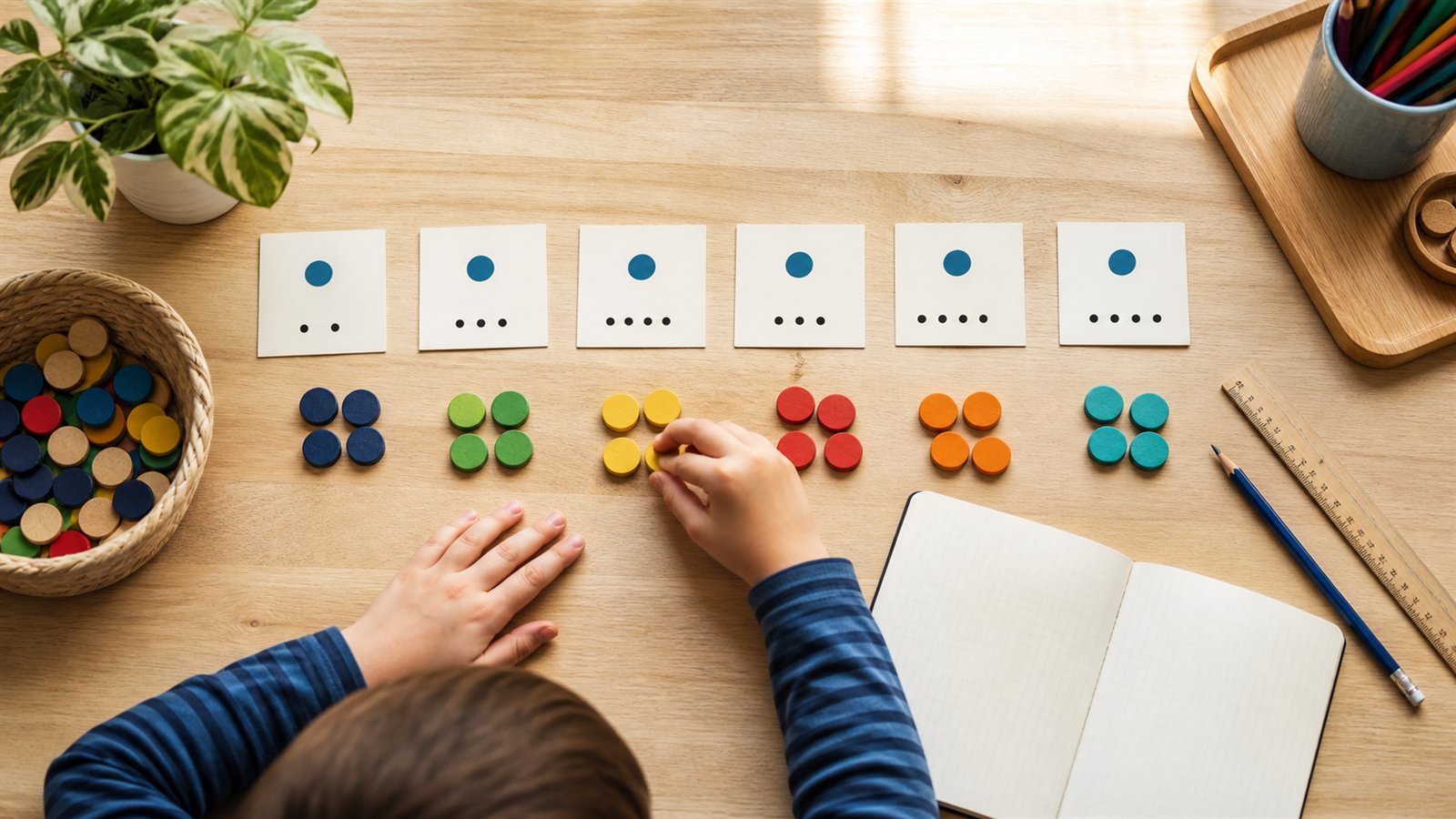
For younger learners, represent the story before writing an equation. Counters, blocks, buttons, toy animals, paper strips, sketches, and number lines can make relationships visible.
For addition, begin with two quantities and physically join them. For subtraction, show a starting amount and remove or compare. For multiplication, build equal groups. For division, start with a total and share it into a known number of equal groups. For fractions, use equal-size parts and attend to the denominator.
Then connect the representation with numbers and symbols. The concrete model is not a detour from mathematics. It provides meaning for the abstract notation.
Addition and subtraction in K–1
The K–1 option keeps addition quantities small and subtraction totals within 20. Read the situation aloud when decoding would distract from the mathematics.
Ask the child to retell the event with objects or fingers. After solving, return the answer to the story: Does that number describe what is there now? A reasonable-answer check can be as simple as noticing that adding should create more and removing should leave less than the starting amount.
Do not make speed the goal. Fluent understanding grows from repeated connections among quantities, representations, language, and symbols.
Addition, subtraction, multiplication, and division in grades 2–3
The grades 2–3 option adds equal-group multiplication and division. These operations should remain connected.
If a problem has six groups with four objects in each group, build or draw the six groups before calculating. For the related division situation, begin with the total and distribute it equally among the known number of groups.
Compare related equations such as 6 × 4 = 24 and 24 ÷ 6 = 4. Ask what each number means in the specific story.
Multi-digit operations and fractions in grades 4–5
The grades 4–5 option uses larger whole numbers and adds fraction problems with like denominators. The generated fraction questions intentionally keep the whole and common denominator visible.
When adding like-denominator fractions, ask what the denominator tells us about the equal-size parts and why it remains the same. Then add the counts of those parts. Equivalent simplified answers are accepted by the tool.
The generator does not currently include unlike denominators, decimals, measurement conversion, area, volume, or multi-step problems. That boundary keeps the automated solutions honest and gives adults a clear view of what the tool does and does not practice.
Teach a repeatable problem-solving routine
Use a short routine across operations:
- Understand: Retell the situation and identify the question.
- Represent: Draw, model, diagram, or organize the quantities.
- Plan: Choose an operation because it matches the relationship.
- Solve: Calculate and keep track of units.
- Check: Return the answer to the original story.
The routine should support thinking, not become a rigid worksheet that adds unnecessary reading and writing to every problem.
Respond to an incorrect answer productively
An incorrect answer can come from different places. Ask the child to show how they represented the story before reteaching calculation.
- If the representation is wrong, reread and act out the relationship.
- If the operation is right but the calculation is wrong, use a worked example or more accessible numbers.
- If the answer is correct but the explanation is unclear, let the child point, draw, or speak before requiring formal written language.
- If language is the barrier, explain unfamiliar words without solving the relationship for the child.
The learning challenge planner can help turn a stuck moment into a specific next strategy. The homework planner can space a longer practice set into manageable blocks.
Use generated problems responsibly
Generated practice should complement instruction, not replace it. A page of random problems cannot diagnose a learning difficulty, choose an intervention, or show whether a child understands every problem structure.
Use a few problems, listen to the child’s reasoning, and vary representations. Stop when practice becomes unproductive. Share persistent concerns with the teacher and ask what models, language, and strategies are being used in class.
Our educational app and game scorecard offers a broader way to evaluate whether a digital practice tool provides meaningful thinking, feedback, accessibility, and privacy.
Sources and further reading
To practice multiplication before returning to a word problem, use our third-grade multiplication games with free printable boards. The array, doubling, and missing-factor games give children ways to explain the facts they use in a story.
- Assisting Students Struggling with Mathematics: Intervention in the Elementary Grades, What Works Clearinghouse.
- Mathematics Intervention Toolkit: Word Problems Module, Regional Educational Laboratory Northeast and Islands.
- Organizing Instruction and Study to Improve Student Learning, What Works Clearinghouse.