Read it · Picture it · Work it out
Generate a math word problem
Try one together, or make a five-problem practice set. Every story comes with a visual model and a worked answer.
Changing a grade, operation or theme starts new practice and clears your work. Pick by readiness; younger children may need the story read aloud.
One small story
A wildlife helper has 82 food portions and receives 82 more. How many food portions are there now?
Picture the story
Enter the number that answers the story.
Your answers and notes stay on this page and are cleared when you leave or start new practice. They are not included in usage analytics. Printing creates blank learner pages and the worked answers.
Want another way to practice? Find a hands-on math activity or try multiplication boards and equal groups.
GrowMindGrow · Read, picture, solve
Math word problems
Grades 2–3 · Addition · Animals
Practice 2-3 / add / animals / 1 · Learner page 1
1. A wildlife helper has 82 food portions and receives 82 more. How many food portions are there now?
Draw or explain your thinking.
My answer: ____________________
GrowMindGrow · Grown-up copy
Worked answers
Grades 2–3 · Addition · Animals
Practice 2-3 / add / animals / 1 · Matches the learner pages
1. A wildlife helper has 82 food portions and receives 82 more. How many food portions are there now?
82 + 82 = 164
Join the two quantities because the second amount is added to the first.
Ten minutes is enough. It is only enough if it is spent on the thing that is actually stuck.
Most home math practice defaults to more of what school sent home, done more slowly, at the end of a day when everyone is tired. That is the least productive version of the ten minutes, because a worksheet a child cannot do at school is not made easier by doing it at a kitchen table with a parent watching.
Early arithmetic rests on four ideas. Almost every stuck child is stuck on one of them, and each has a version you can do in ten minutes with what is already in the house.
One: the last number you said is the answer
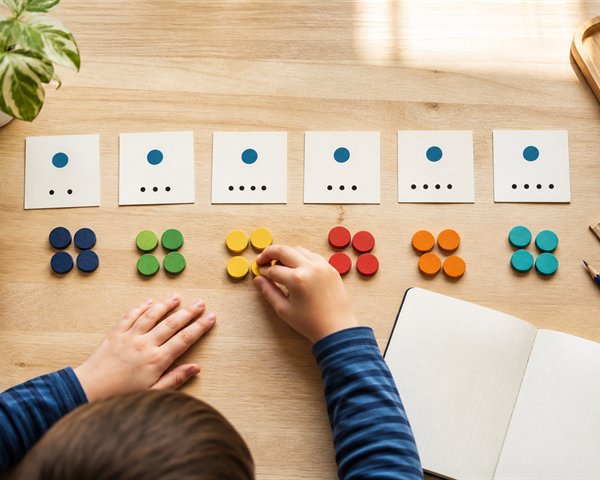
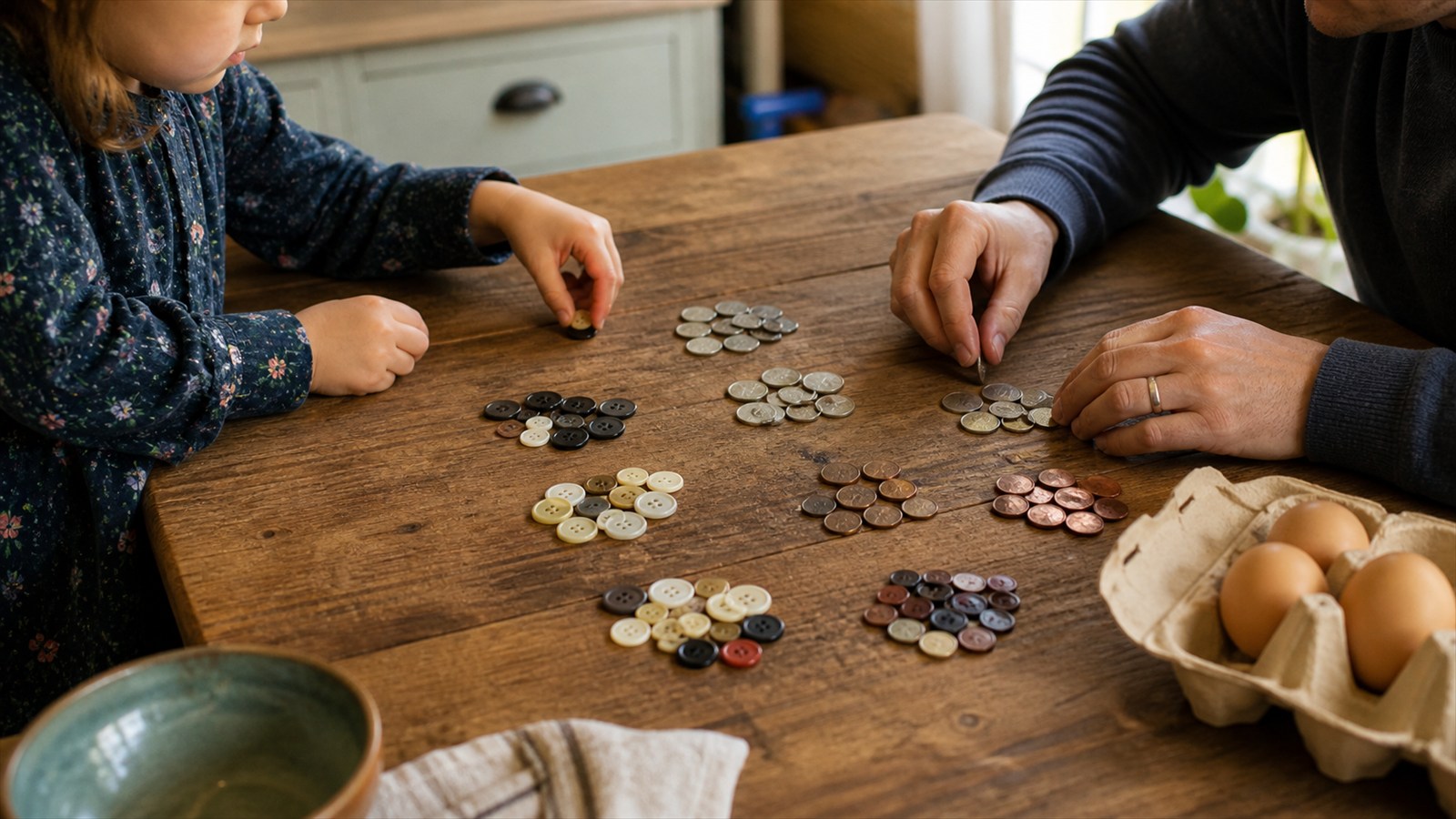
Ask a child to count six buttons. Then ask how many there are. If they count again, the idea has not landed yet.
This is cardinality, and it sounds too small to matter. It is the foundation of everything after it: a child who recounts every time cannot hold a quantity in mind, and holding a quantity in mind is what addition is.
What to do: count a small set together, cover it, and ask how many. The covering is the whole exercise — it removes the option of recounting and forces the total to be held. Vary the arrangement, because a child who counts five in a line and is unsure about the same five in a circle has learned the arrangement rather than the number.
Two: ten is a thing, not ten things
Twelve is a ten and a two. Adults have forgotten this was ever a discovery.
Until it lands, a child does arithmetic by counting up in ones, which works until about twenty and then stops working. Every later method — carrying, borrowing, mental addition — assumes the ten is a single object that can be handled as one.
What to do: build teen numbers deliberately out of one group of ten and some loose ones. Egg boxes are the right shape for this by accident; ten eggs and three left over is thirteen in a form a child can see. Say the structure out loud as you go: a ten and a three makes thirteen. The irregular names — eleven, twelve, thirteen — are the ones to spend longest on, because they hide the structure the others show.
Three: the bonds to ten, known cold
Which pairs make ten. Six and four. Seven and three.
This is the one piece of memorisation in early math that genuinely pays. Not because recall is the goal, but because a child who knows eight and two can do eight plus five by going through ten, and a child who does not has to count on five ones every time.
What to do: this is the one that suits repetition and speed. Ten counters, hide some, how many are hidden. Short and often beats long and occasional — two minutes daily will outrun twenty minutes on Sunday.
Four: the exchange
Ten ones become one ten. One ten becomes ten ones, when you need them.
This is what carrying and borrowing are, and it is where most second-grade arithmetic falls over. The written procedure — the little one above the column — is a notation for a physical trade. A child who has done the trade with objects has something to fall back on when the notation blurs. A child who has only met the notation has nothing.
What to do: do the trade physically before doing it on paper. Group ten small objects, swap them for one distinguishable object, and be explicit that the amount has not changed. The moment worth waiting for is a child objecting that the pile got smaller — that objection is the idea arriving.
Where the word problems fit
The generator above produces problems with the answer and the reasoning attached, which makes it useful for the part most people skip: talking about the situation before touching the numbers.
The question worth asking is not what is the answer but what is happening here, and is the answer going to be bigger or smaller than what we started with. A child who can predict the direction has understood the problem. The arithmetic after that is the easy half — and it is the half that gets all the practice.
What ten minutes should feel like
For a child moving into equal groups and multiplication, our seven third-grade multiplication games extend this hands-on approach with dice, cards, arrays, and a printable pack. Start with the game that matches the concept being taught at school.
Short, spoken, and mostly about things rather than symbols. Nobody should be tired at the end of it.
If a child is getting everything right, the practice is too easy to be doing anything. If they are getting most of it wrong, the idea underneath has not landed and drilling the level above it will not help — drop down one of the four ideas above and work there instead.