

Play a sample on our play site
Online number games
Try counting sequences and making ten, with real game previews and tips for playing together.
Find a learning game GrowMindGrow
Little games. Big discoveries.
A handful of counters. A roll of the dice. An “I figured it out!” moment. Find a short math activity for kindergarten through grade 5.
Find your five-minute gameFree activities & printables · No signup
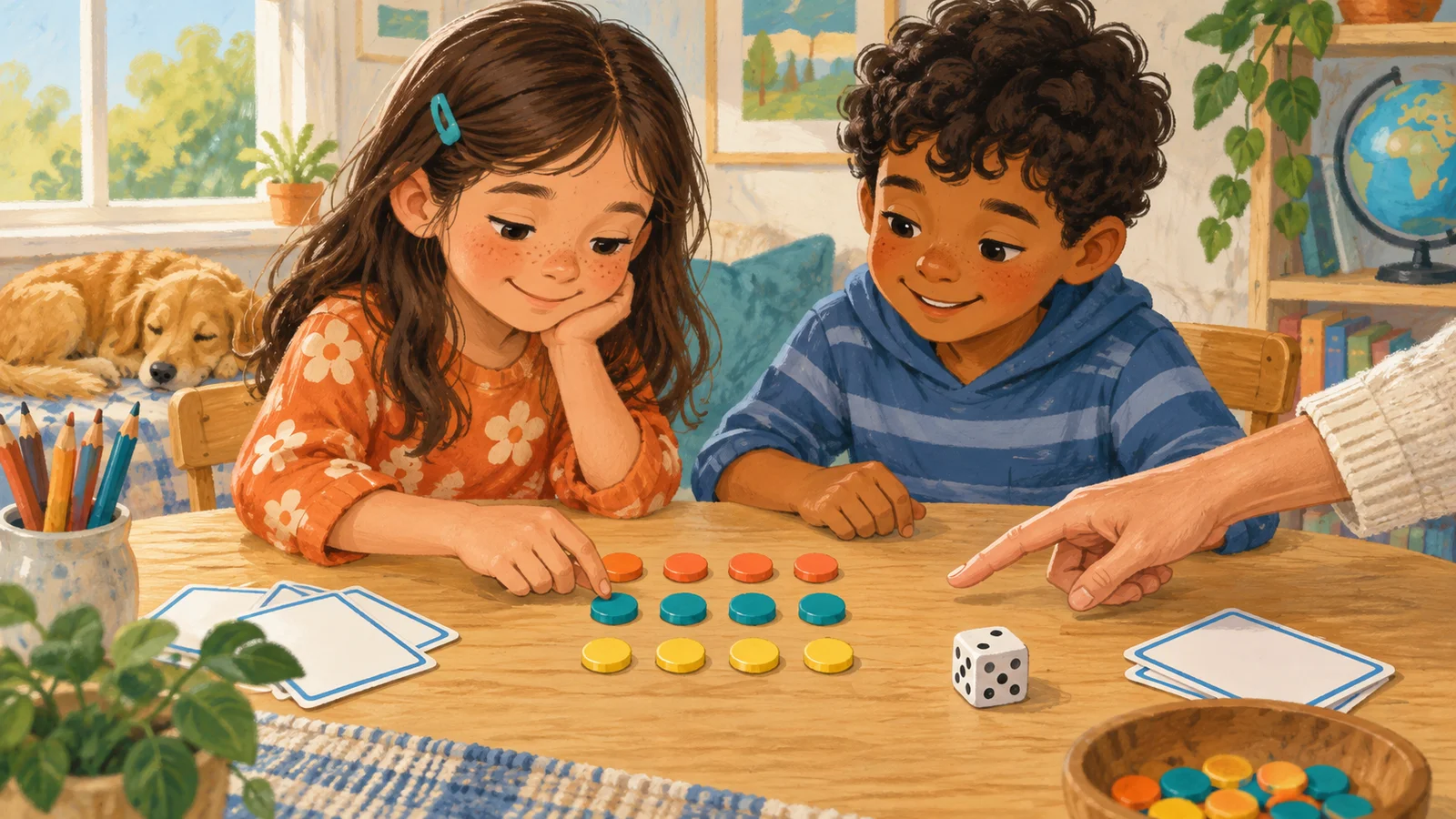
Where shall we start?
Grades are a guide. Choose the skill your child is ready to explore, and make it easier or harder together.
Would a skill be easier than a grade? Find an activity by skill.
The six games below use everyday materials away from the screen. For practice in your browser, try our math word problem generator.
Or start from a skill
Every resource here, grouped by what it practises. Each says who it usually suits, how you use it, and what your child can already do when it fits. Grades are only a guide.
How many, and what comes next.
Ready when: Counts up to 10 objects, touching each one.
Ready when: Can count on from a number instead of starting again at 1.
Ready when: Enjoys a short game with a grown-up nearby. The play site may ask for an account after several games.
Joining amounts, and finding the total.
Ready when: Counts two small groups to find how many altogether.
Ready when: Adds within 10 or 20 by counting on.
Ready when: Adds within 20 and is starting on two-digit numbers.
Ready when: Can follow a short story read aloud.
Taking away, and finding the difference.
Ready when: Can remove a group from a total and count what is left.
Ready when: Knows that taking away makes the number smaller.
Ready when: Subtracts within 20 and is ready to find the gap between two numbers.
Ready when: Can follow a short story read aloud.
Equal groups, rows and arrays.
Ready when: Can skip count by 2s, 5s or 10s.
Ready when: Understands equal groups and is building up facts.
Ready when: Recognises equal groups in a story.
Count & compare · About 5 minutes
A little collection becomes a way to see how numbers fit together.
Gather: Paper, a pencil and 10 counters
You have filled 7 spaces. How many more make 10?
3 more. The top row holds 5 and the bottom row has 2, leaving 3 empty spaces.
Make it yours. Start with one row of five. For a new challenge, briefly show the frame before covering it.
Next: count on along a number line to 10 Choose another gradeAdd & subtract · About 5 minutes
Let two rolls set the scene for a tiny number story.
Gather: Two dice and 12 counters
There are 2 birds, then 5 arrive. How many birds are there now?
7 birds. Join the groups: 2 + 5 = 7. You can start at 5 and count on 2.
Make it yours. Use counters throughout. When that feels comfortable, explain a way to find the total without counting every counter.
Next: add and take away on a number line Choose another gradeTens & ones · About 5 minutes
Take turns being the builder and the number detective.
Gather: Paper and a pencil
Your drawing has 4 tens and 6 ones. What number did you build?
46. Four tens make 40, and 6 ones make 6: 40 + 6 = 46.
Make it yours. Begin with teen numbers. Later, ask how the drawing changes when you add 10 or subtract 1.
Next: take the tens first on a number line Choose another gradeMultiplication · About 5 minutes
Discover how a rectangle can tell a multiplication story.
Gather: Two dice and up to 36 counters
There are 3 rows with 4 counters in each row. How many counters?
12 counters. Three groups of 4 make 12: 3 × 4 = 12. Turn it to see 4 rows of 3.
Make it yours. Begin with 2 or 3 rows. For more practice, try the seven games and printable boards linked below.
Next: seven more multiplication games Choose another gradeEquivalent fractions · About 5 minutes
Different numbers can describe the same amount of a whole.
Gather: Two equal-length paper strips and a pencil
Which fraction in fourths matches one half?
2/4 matches 1/2. Two of the four equal parts cover exactly the same length as one of the two equal parts.
Make it yours. Keep the strips lined up while comparing. Later, predict an equivalent fraction before folding to check it.
Next: fraction word problems, with pictures Choose another gradeFractions & division · About 5 minutes
Open an imaginary café where everyone gets a fair share.
Gather: Paper and a pencil
Three friends share 2 pizzas equally. How much does each friend get?
2/3 of a pizza each. Cut both pizzas into thirds. Give each friend one third from each pizza: 1/3 + 1/3 = 2/3.
Make it yours. Start with 1 pizza shared by 2 friends. When ready, explore 3 pizzas shared by 4 friends.
Next: sharing word problems, with pictures Choose another gradeKeep the curiosity going
Play a sample on our play site
Try counting sequences and making ten, with real game previews and tips for playing together.
Find a learning gameUse in your browser
Choose a K–5 grade band, operation and theme. Check an answer, reveal the worked solution or print a problem.
Make a word problemPlay away from the screen
Dice, cards and equal groups, with a free six-page pack of boards, fact cards and answer support.
Explore multiplication gamesFor parents & caregivers
Find a manageable routine for talking through numbers together, with practical ideas for short sessions.
Plan a ten-minute sessionUse in your browser
Jump one step at a time to add and take away within 10 or 20. As many tries as you like, with no timer and no score.
Jump along the lineWorked examples & free printable
Add and subtract by jumping along a line, with six worked examples, the mistakes that cause most wrong answers and a printable practice pack.
Follow the worked examples