


Sight Word Checklist
Fry’s first 100 high-frequency words, with three passes for progress.
Free. No account, no email, nothing to install.Families and teachers · K–2
Choose another starting point in our reading games for kids: letter matching, word blending, spoken sound games and a tiny story to explore together.
Ready to practice common words together? Try our sight word games and printable word picnic cards.
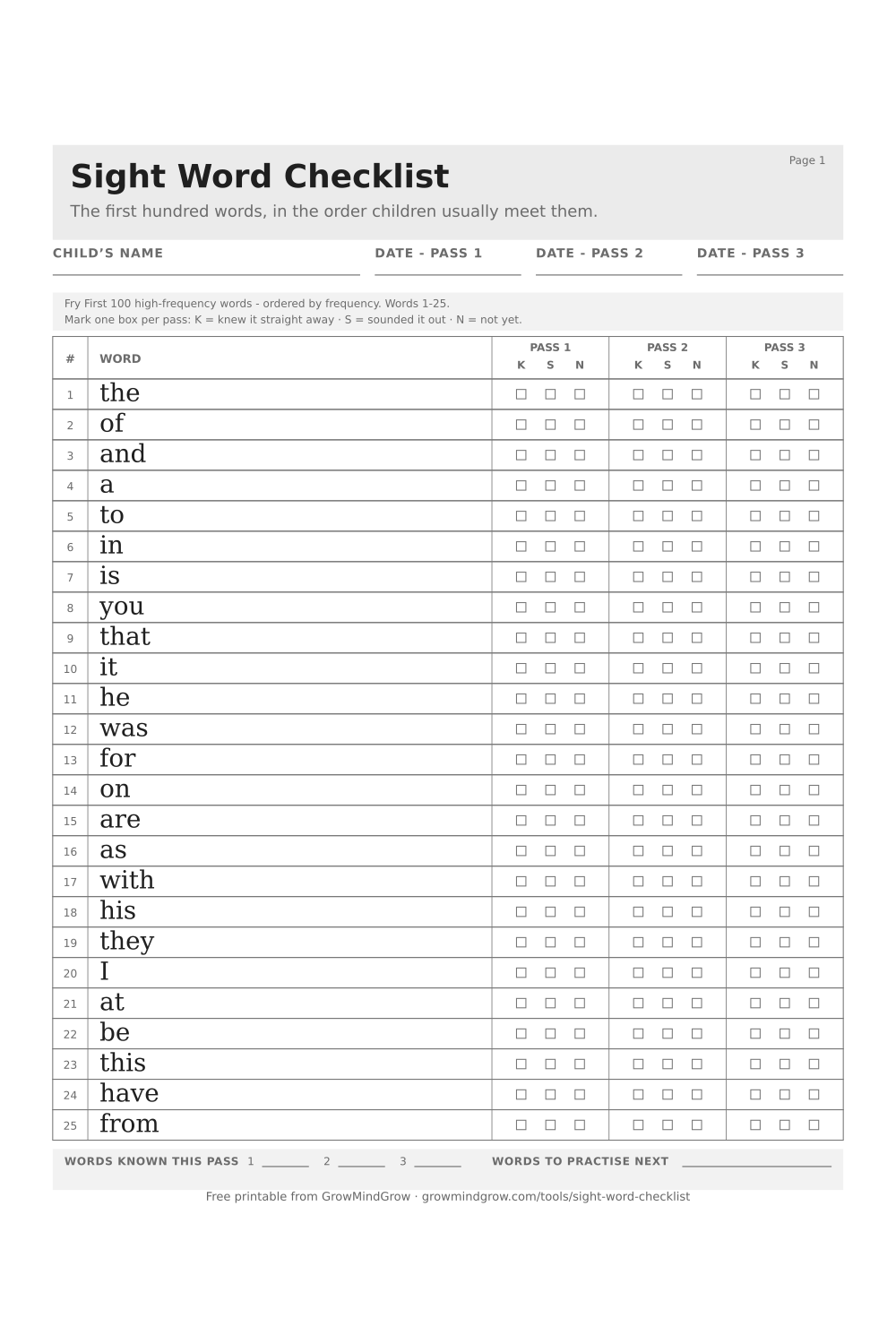
No email address, no account. Print as many as you need, including for a whole class.
For schools and PTOs
Put your school's name on it
Type a school name and it appears on the sheet. Print a class set or a school set — there is nothing to buy and nothing to attribute.
The name you type stays in this browser. It is not sent to us, not saved, and not recorded anywhere — closing the tab is enough to remove it. In the print dialog, choose Save as PDF to keep a copy.
What the sheet asks
- Child’s name
- Date — pass 1, pass 2 and pass 3
- Word
- K — knew it straight away
- S — sounded it out
- N — not yet
How to use it
- Print all four pages and keep them together.
- Show each word and mark K, S or N after the child reads or tries it.
- Come back in a fortnight and fill the next pass in a different colour.
Early in the year, and then again every few weeks — the point of the three passes is that one sheet shows movement over a term rather than a single snapshot. Sit beside the child, show one word at a time, and mark one box after they read or try it. Use a different colour for each pass and the progress is visible without reading a number. Twenty-five words a page is about as much as a five-year-old will do in one sitting, so treat a page as a session.
Questions people ask
- Which hundred words are these?
- Fry’s first 100, in frequency order — a widely used high-frequency word list. The earliest words are the most common in the source list. Fry is named on the sheet so a teacher using Dolch or another list knows before printing.
- Why three passes instead of one tick?
- Because a word known in October and forgotten in January is the thing worth catching, and a single tick cannot show it. Three columns turn the same sheet into a record of what is sticking and what is not.
- May I photocopy this for my whole class?
- Yes. Print, copy and hand out as many as you need, for a class, a year group or a whole school. There is no licence to buy and nothing to attribute.
- What is the difference between K, S and N?
- K is knew it straight away, with no pause. S is sounded it out, which is real progress and not the same as knowing it by sight. N is not yet. The three apart tell you what to practise; a single tick would not.
The thinking behind it
Fry's First 100 Sight Words: Printable Checklist and Three-Pass Assessment
A sight-word checklist should show more than a permanent tick. This one separates words known automatically, words decoded successfully, and words that need teaching, then records three passes.
7 CVC Blending Games for Kindergarten and Free Printable Word Cards