Want just the tool? Sight Word Checklist has its own page — easier to bookmark and to pass on.
Fry’s first 100 words appear so often that a beginning reader benefits from recognizing them efficiently. But “recognize efficiently” does not mean “memorize the shape of a hundred words.” Many of the words can be decoded with sound–spelling knowledge. Others contain a part that needs direct attention. All of them make more sense inside reading and writing than as an isolated race through cards.
The free Fry sight-word checklist gives each word three possible observations—knew it, sounded it out, and not yet—and room for three dates. That distinction keeps successful decoding visible while showing which words have become automatic.
Fry’s first 100 words
The words below are arranged in Fry frequency order and divided into the same four sets of 25 used by the printable.
Words 1–25
| 1–5 | 6–10 | 11–15 | 16–20 | 21–25 |
|---|---|---|---|---|
| the, of, and, a, to | in, is, you, that, it | he, was, for, on, are | as, with, his, they, I | at, be, this, have, from |
Words 26–50
or, one, had, by, word, but, not, what, all, were, we, when, your, can, said, there, use, an, each, which, she, do, how, their, if
Words 51–75
will, up, other, about, out, many, then, them, these, so, some, her, would, make, like, him, into, time, has, look, two, more, write, go, see
Words 76–100
number, no, way, could, people, my, than, first, water, been, called, who, oil, sit, now, find, long, down, day, did, get, come, made, may, part
The list is a frequency sequence, not a national grade-level standard. A school may use Fry, Dolch, a curriculum-specific list, or words selected from the phonics sequence and books children are reading. Before turning the list into a target, ask which words the teacher is actually teaching and how they want families to practise them.
Sight words and high-frequency words are not identical
A high-frequency word appears often in written language. A sight word is any word a particular reader recognizes automatically, without having to work through it during that reading. A word can be high frequency without yet being a sight word for the child. A less common word can become a sight word after the child has read it many times.
This matters because the aim is not to store each word as a visual picture. Reading Rockets’ explanation of sight words and orthographic mapping emphasizes connecting sounds, spellings, and meanings. Repeated attention to those connections helps a word become immediately retrievable.
Some high-frequency words are regular once the reader knows the relevant phonics pattern. Others have an unexpected part. In said, for example, the first and last sounds are represented as expected while the vowel spelling needs special attention. Showing both the regular and unexpected parts gives the child something more useful than “you just have to remember it.”
How the three-pass checklist works
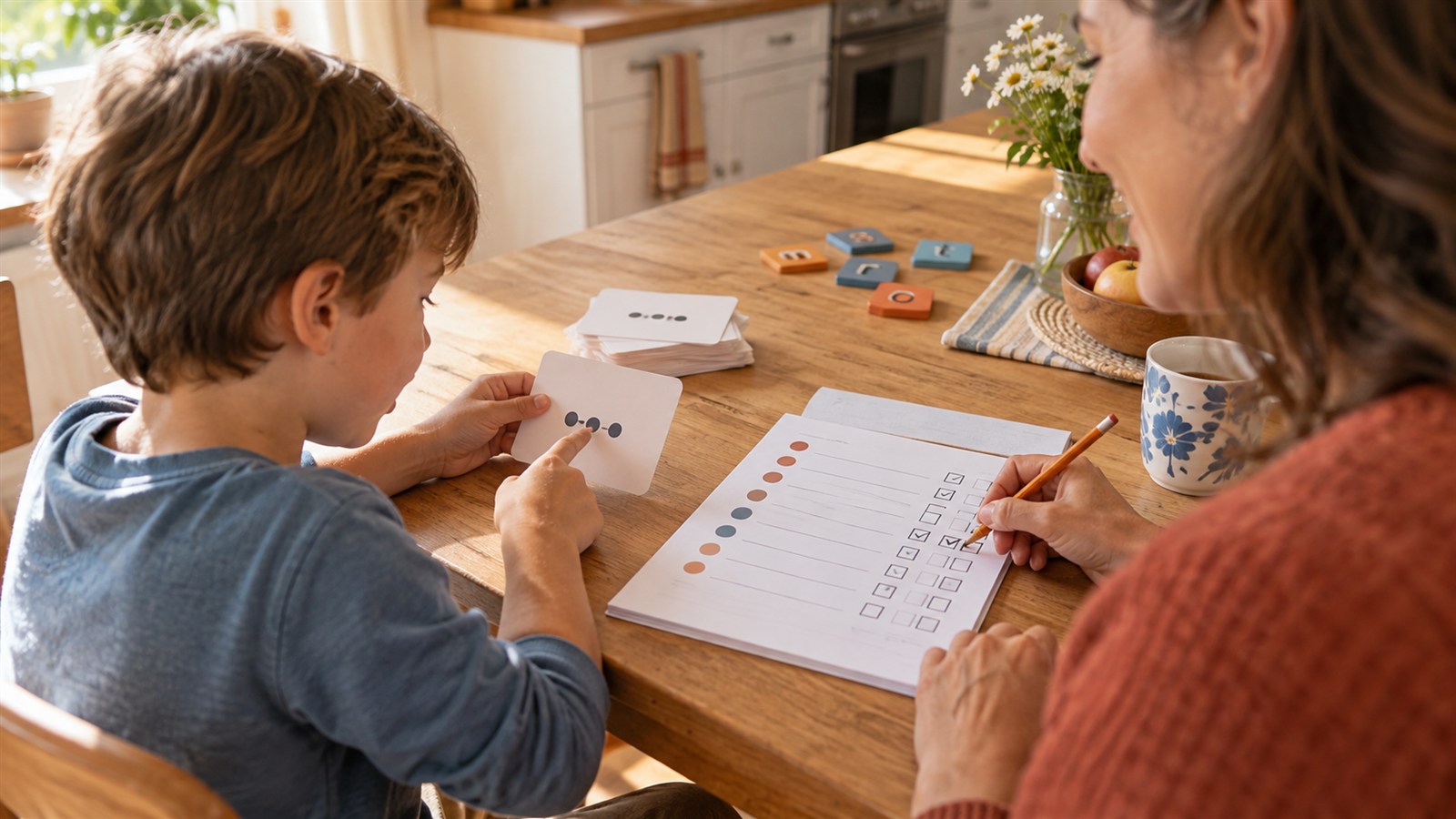
Print all four pages and write the child’s name at the top. Each page contains 25 words and three dated passes. For every word, mark one observation:
- K — knew it straight away: The child recognized the word automatically in this check.
- S — sounded it out: The child used decoding or another deliberate word-reading strategy and reached the word successfully.
- N — not yet: The word was not read accurately this time.
“Sounded it out” is not a lesser version of success. It is the process that can make future automatic recognition possible. Keeping S separate from N prevents the checklist from treating productive decoding as failure.
Use a different pencil color for each date if that makes progress easier to see. The letters still carry the information when the pages are photocopied in black and white.
Conduct one short first pass
Begin with one page, not all 100 words. Sit beside the child in a quiet place and explain the three marks without presenting them as grades.
Show one word at a time. If the child reads it immediately, mark K. If they pause and work through it accurately, mark S. If they do not know it, supply the word calmly, mark N, and continue. Do not leave a child stranded while a timer runs.
Stop if accuracy drops because the child is tired, restless, or upset. The purpose is to find a useful starting point. Twenty-five words tomorrow will tell you more than a forced hundred today.
The U.S. Department of Education’s foundational reading practice guide recommends teaching both regular and irregular high-frequency words, applying letter–sound knowledge to regular words, and giving enough repeated practice for recognition to become efficient. Assessment is useful only if it changes what is taught next.
Choose what to practise next
Do not begin automatically at word one. Look at the first-pass marks and select a small group that fits current instruction.
A practical set might contain:
- two words marked S that are close to becoming automatic;
- two words marked N that use a sound–spelling pattern the child already knows; and
- one irregular word that appears frequently in the child’s current books.
Three to five words leave room to notice each spelling, use each word, and revisit earlier learning. A stack of 30 cards mostly measures endurance.
Teach the word instead of drilling its outline
For each selected word:
- Say the word naturally. Make sure the child knows its meaning.
- Stretch or segment the sounds. Keep the pronunciation accurate rather than distorting it to match the letters.
- Map sounds to spellings. Point to the regular parts and name any unexpected part explicitly.
- Build or write it. Letter tiles, handwriting, and saying the sounds while writing all direct attention to the sequence.
- Read it in a sentence. Find the word in a familiar book or write a short sentence that makes its meaning clear.
- Return later. Mix it with known words rather than presenting it in the same predictable position every time.
Reading Rockets’ model for teaching high-frequency words explains why separating regular and irregular spellings is more accessible than asking children to memorize every word in the same way.
Repeat the check without turning it into a weekly test
Use the second and third passes after enough instruction and reading have happened to make change plausible. Every fortnight may suit one classroom; another child may need longer. The dates are there to record learning, not impose a universal schedule.
Compare the pattern of marks:
- N to S shows that the child can now work through the word.
- S to K suggests recognition is becoming automatic.
- K to S or N may mean the first response was not stable, the child was tired, or more cumulative review is needed.
- Repeated N marks across words with the same spelling pattern can point to a phonics skill that needs instruction, not 10 unrelated words to memorize.
Do not turn a total K count into a reading level. Word recognition is only part of reading, alongside language, fluency, knowledge, and comprehension.
Use the words in connected reading and writing
If a child is still learning to join familiar letter sounds into words, try our seven CVC blending games and printable word cards. They focus on regular short-vowel patterns, a different job from tracking this high-frequency word list.
A checklist can organize attention, but children learn to read by reading text. Look for the selected words in decodable passages and books the child can understand. Read sentences aloud together. Invite the child to write a message using one or two of the words. Keep talking about the story or information so word practice continues to serve meaning.
The free reading discussion card generator can help keep comprehension in the conversation, while the printable weekly reading log records books and minutes without pretending that a word-list score describes the whole reading experience.
If a child persistently struggles to connect letters and sounds, read unfamiliar words, or make progress with explicit instruction, share the actual checklist pattern with the teacher. “These eight words still require help after three passes” gives the school more to work with than “sight words are hard.”
Download the four-page Fry checklist
The Fry first 100 printable checklist is free, requires no email address, and may be copied for a family, class, year group, or school. It is designed for US Letter paper and works in black and white.
Keep the four pages together, date each pass, and let K, S, and N describe what happened—not what kind of reader the child is.